
Land of the rising galaxy
After last year’s successful (by my amateur standards) Milky Way sighting, I knew I had to go back in 2021 to capture more Milky Way shots and improve my technique. We returned to the Sunrise Visitor’s center at Mt. Rainier national park on a brisk September night. With clear weather, the altitude and darkness of this remote spot is perfect for stargazing. Having Mt. Rainier as a foreground is also hard to resist.
After arriving at Sunrise, we actually spent some time trying to find a better vantage point along Sunrise road for shooting the mountain and the Milky Way. Last time, the camera would frequently get blinded by cars leaving the lot (there are a lot of night time hikers) or get obstructed by (well-meaning) unaware hikers walking past my setup. This time we found a spot closer to the ridge and the edge of the parking lot, resulting in far fewer cars driving by while I was trying to shoot. Headlights still messed up quite a few of my pictures though. The real solution may be to go further out on a trail, but being able to access things in the warm trunk of our car is very convenient. Interestingly, we did drive past someone on the side of Sunrise road with a pickup truck with floodlights and a DJ setup, maybe I can branch into album cover artistry next.
Stacking Up
The Milky Way looked beautiful on this night, and I managed to snag a lot of photos at shorter and longer exposures. The big things I wanted to try this time were stacking, higher ISO, and longer exposure. I’ve actually developed a couple of photos out of this trip, but I’m going to talk about my favorite one, which was a result of me messing around with stacking.
Stacking generally refers to “stacking” multiple photos (taken in sequence at the same exposure and camera settings) on top of each other. By combining multiple pictures and applying some form of a median filter and alignment correction, you can filter out a lot of camera noise and extraneous light noise in your shots, leaving behind a more pure representation of the true stars in the sky and the features of our galaxy. People create truly incredible night sky photos by stacking tens of images and processing them.
I tried taking repeated shots at a few different points during the night, and I ended up with one set of 5 raw photos that had the composition and lighting that I liked. At this point in the trip, I still was not sure if I would be able to get anything good out of a stacked image, so I was also experimenting with longer exposure and high ISO images a lot. After going through all the edits, I wish I had more than a set of just 5 raws for stacking. Alas, next time.
The photos I stacked had an f-stop of f/1.4, 5 second exposure, and 2500 ISO. I used StarryLandScapeStacker for Mac to stack the raw images, and edited the resulting image in Affinity. This time around I spent way more time blending different layers to bring out the contrast in the Milky Way band and core while retaining some of the darkness of the rest of the night sky. I was also playing with color balance a bit more – I’ve seen a lot of great Milky Way photos that are yellow-dominated and a lot that are blue-dominated. I tried to retain the blue-dominated sky while keeping the core of the Milky Way yellow and magenta, but in the future I do want to try more yellow-dominated or even some more sci-fi style green/magenta-dominated color balances.
Levels, shadows, and contrast editing were crucial to bringing out the core. I layered the core with slightly higher exposure for the mountain, and basically the default stacked image for the rest of the ambient sky. Blending these together resulted in an image that I am really happy with.
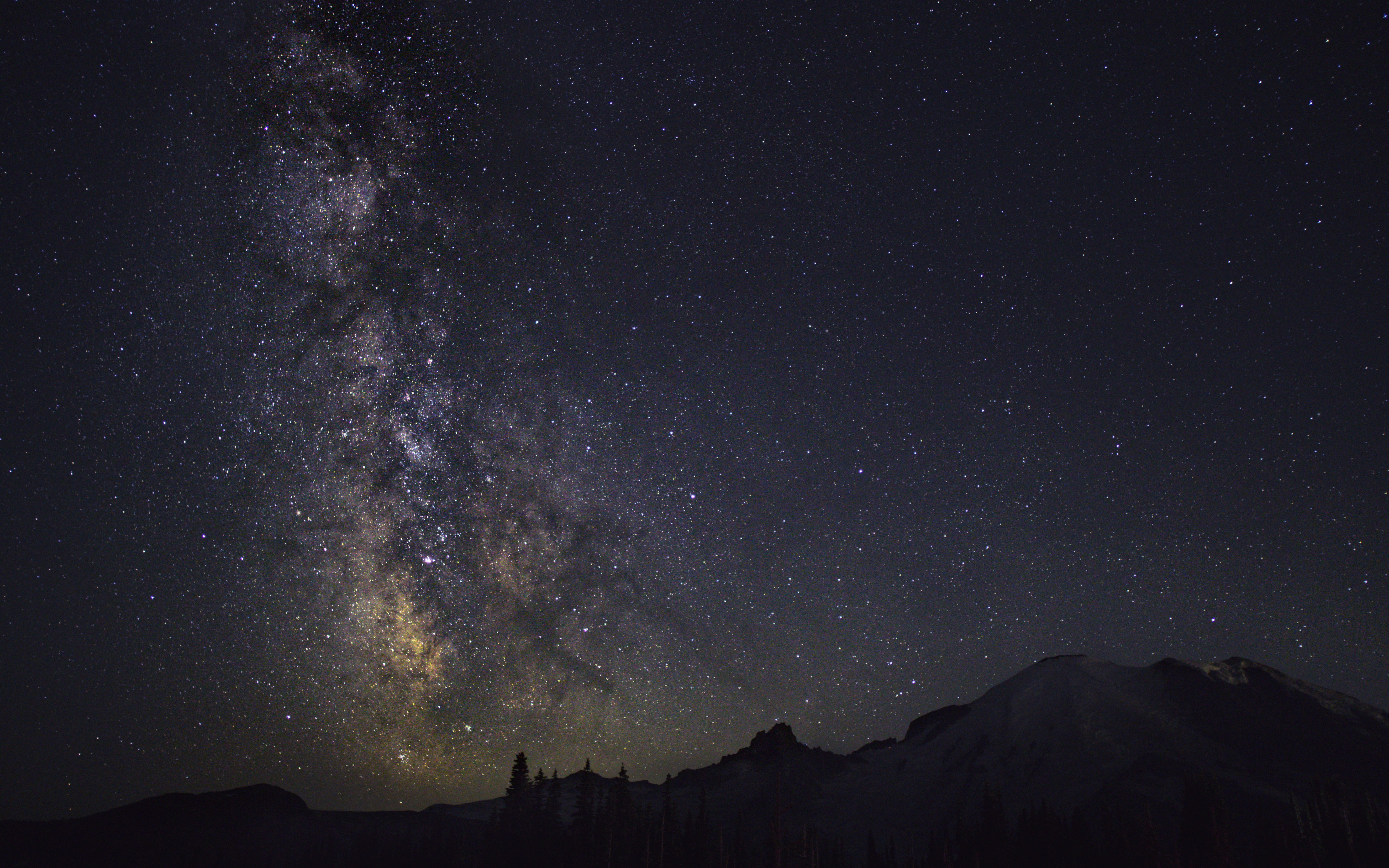
I was amazed at the clarity that came out of stacking just 5 photos together. The amount of stars visible, and their clarity, is incredible. On another shot (with a 30 second exposure) that I developed, I had to de-noise the raw image significantly since a lot of stars were a bit streaky and did not look good when blown up. This is where the median filtering and star identification associated with stacking really flexes its muscle. I did not think I’d be able to capture this level of detail on my second night sky trip.
Overall, stacking photos and spending more time layering than raw editing really helped me up my game on this shoot. Given how much better my results were stacking 5 photos, next time I definitely want to try stacking 10 or 20. The season is mostly over now though, and the road to Sunrise is snowed in. I’m excited for next year, since I also want to try going earlier in the season when more of the core is above the horizon. The tilt of the Earth’s axis relative to the ecliptic plane, the plane of our orbit around the sun relative to the Milky Way core, and our latitude in the northern hemisphere all impact when and how much of the Milky Way is visible to us. Until then, ad astra.

 Roshan Radhakrishnan
Leave a reply to Ilene Cancel reply