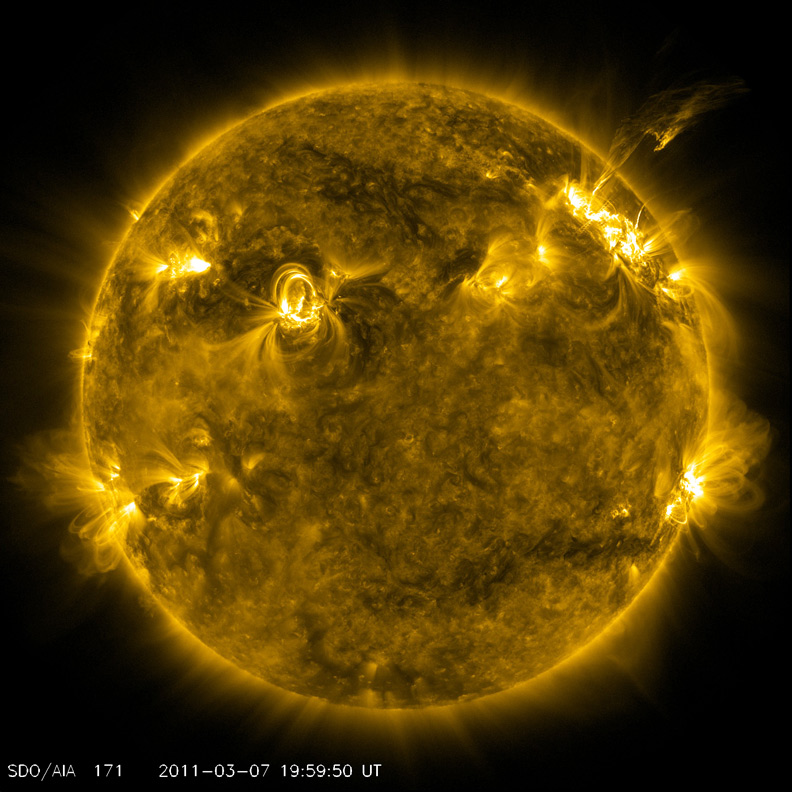
Earlier this week, the NASA Solar Dynamics Observatory posted this video of the sun observed through multiple wavelengths in ultra HD (4k). This is a pretty amazing view of the sun. Making observations in different wavelengths allows astrophysicists to view different behaviors on the sun’s surface, and allows them to “filter” out certain behaviors so they can get clearer views of others.
One of the really cool things you can see in that video is the granular surface of the sun; the granules are the tops of convection cells. This means that as the material inside the sun heats up, it rises to the surface and forms the bright parts of the granules. As the material cools, it sinks back into the sun and forms the dark borders on each granule. Granules have always been one of the most fascinating parts of the sun to me personally. Their geometry reminds me of a dry desert on Earth and almost makes the sun seem terrestrial.
Another, scarier, feature of the sun are Coronal Mass Ejections, or CMEs, and the other forms of solar weather that have the potential to be devastating to Earth and humans. These solar events basically consist of a large number of charged particles being violently ejected from the sun and hurtling towards Earth. Usually, the Earth’s magnetic field provides protection against these kinds of events. If the CME is powerful enough, however, it could still propagate through the magnetic field and wreak havoc on any satellites in orbit. This may sound inconsequential, but when you realize that everything from GPS to television to communications relies on satellites, it becomes a serious threat. That is part of the reason that NOAA has been pressured by the White House to develop a comprehensive space weather strategy that potentially involves private companies. As we become more reliant on space technology in our everyday lives we need to develop more robust risk mitigation. There are already some very basic space weather forecasting capabilities, but as the previously linked SpaceNews article mentions, they are spread out among many government agencies and very decentralized.
Clearly there is a lot of interesting stuff going on with the sun, from both a science and policy standpoint. I definitely wish I could take some kind of heliophysics or astrophysics class. Grad school maybe..
 Roshan Radhakrishnan
Leave a comment