
Its a fall weekend, so some form of football, whether it be college or NFL, is on most people’s minds. But football isn’t the only place where interceptions are interesting. Interplanetary interception trajectories are pretty amazing in their own right. They are the only way for us to actually reach another planet efficiently. For example, if NASA wants to go to Mars, they can’t just point a rocket at where Mars is right now and fire, because in the 2 months it would take to get there Mars would have flown away. Instead, we have to “lead” the planet and aim for where Mars is going to be once we get there. Obviously this poses some pretty challenging problems.
One way to account for the motion of Mars in your interplanetary travels is to solve Lambert’s Problem. Lambert’s Problem is incredibly important in astrodynamics; it provides a method for finding an orbit given two points in space and the amount of time it takes to travel between them. This means we can specify that we want to go from point 1 to point 2 in x amount of time, and solving Lambert’s Problem will give us the velocities and other parameters needed to describe a trajectory between point 1 and point 2 that satisfies our time constraint. So for our case, we could say that we know where Mars is going to be 2 months after we launch (assuming we only have the thrust capability to get to Mars in 2 months), so we could solve Lambert’s Problem to get a heliocentric orbital trajectory that gets us there in the required timeframe. The actual algorithm itself is almost absurdly hairy though. Not something you want to do by hand.
Let’s continue the above example, and say we want to go to Mars from the Earth. Using an implementation of Lambert’s problem to solve for the initial velocity of our spacecraft (which gives us the interception trajectory), we can integrate the equations of motion of the spacecraft, the Earth, and Mars to plot our path through the stars.
The equations of motion (EOMs) used here are fairly straightforward; the sun’s gravitational force is treated as the only force on each planet. This is usually a good approximation. Realistically, you would also consider the forces of the planets on the spacecraft during certain parts of the orbit, but that is getting more into the patched conics approach to interplanetary travel. Integrating the EOMs and plotting them results in the following trajectory.
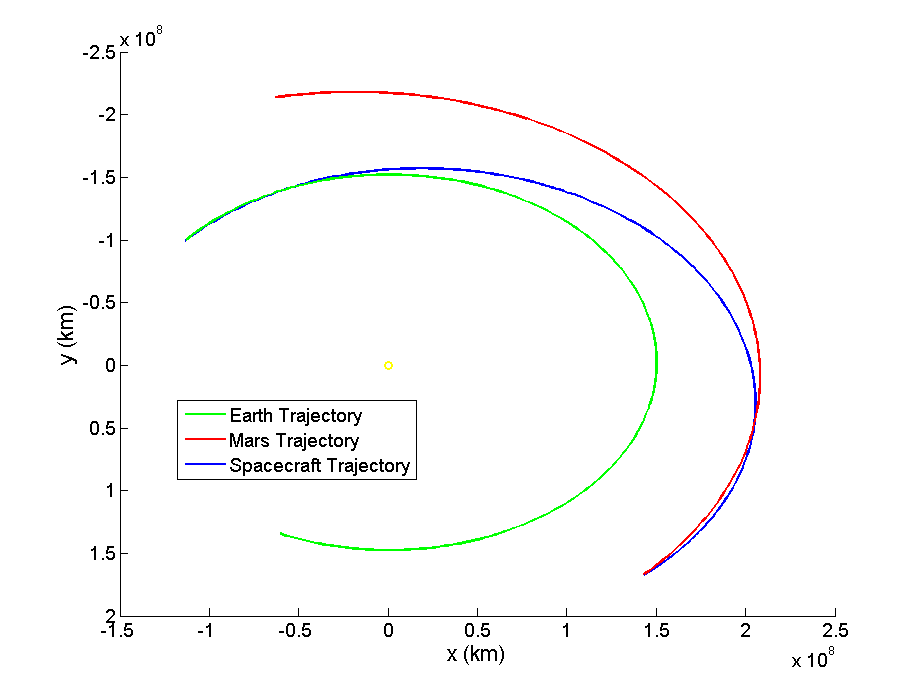
You can see that Mars starts “ahead” of the Earth, and the spacecraft catches up to it nicely. This plot doesn’t reveal the whole story, however. Check out what is happening in 3D.
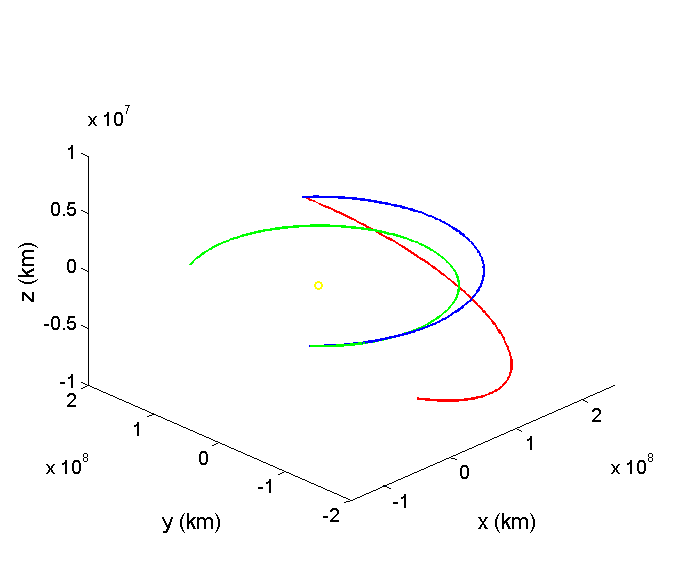
The legend is the same, green for Earth, blue for our spacecraft, red for Mars. What this shows is that Mars is actually on a slightly different inclination than Earth (the axes are scaled so the inclination difference is obvious), so intercepting it isn’t as easy as flying along a 2D plane. The spacecraft also must change it’s inclination to reach Mars, but Lambert takes care of that for us. It is amazing what you can do with problems that have already been solved. The only real downside to Lambert’s problem is that due to the iterative and numerical nature of solving it, you won’t always get a solution.
I know this 3D plot isn’t as neat as the last few, I have not been able to get a good looking and easy to understand plot for this problem sadly. I’ll probably go back to the attitude dynamics simulations for next time. I have an idea on propagating the orbit of the spacecraft using proper dynamics. The end goal there is to couple attitude and orbital dynamics via drag. We’ll see how it goes.
 Roshan Radhakrishnan
Leave a comment